For those of you stuck inside from all the bad weather, here's Part 2 of the interview we did with Steve and Brandy on thesailingrode.com. Be sure to add their podcast subscription to your podcasts on your iOS or Android device. It's a young podcast but already shows a tremendous amount of promise. Hope you enjoy!
(or how to move onto a sailboat) With the advent of our 50th birthdays came the usual sorts of life evaluations that one goes through. At what have I succeeded? What contributions have I made? What do I have left that I want to do before I die? Living on the water was high on both our lists. For any who share the dream, and for our family members who might not understand, this is our story. We don't know where it will take us, but welcome along for the ride!
Showing posts with label How NOT to Buy a Cruising Boat. Show all posts
Friday, January 29, 2016
Thursday, January 21, 2016
The Sailing Rode
Posted by
Deb
If you haven't had a chance to download any of the podcasts from thesailingrode.com, this might be your chance. We were invited by Steve and Brandy, the purveyors of The Sailing Rode, to do a podcast about how we realized the dream of cruising and a bit about our book.
Not being familiar with Steve and Brandy's podcast, we headed on over to thesailingrode.com and listened to some of the podcasts that they had already published. They released their first podcast in August of last year and, even though it's a young podcast, we found the podcasts to be well crafted, educational, and very entertaining. We signed on, and did the podcast interview last week. Part One was released today, and Part Two will be released next week. So if you're downloading podcasts for your overnight passage, or one to listen to while being parked during the many cold fronts this season, go on over to The Sailing Rode and check out their content.
![]() |
| Steve and Brandy from The Sailing Rode |
Wednesday, November 11, 2015
Looking for a show
Posted by
TJ
Our little book on “How NOT to Buy a Cruising Boat” has made a tiny little splash in the cruising community. Having garnered some nice reviews from people with a long history of sailing and living on boats, it has also gotten us involved in a conversation or two in the blogger's world. Usually the conversations revolve around an equipment choice or the size and style of boat to be considered. And, somewhere in nearly every conversation, comes mention of the pitfalls, trials, and generally miserable condition of the boating industry when it comes to the manufacturing, marketing, maintenance, and support offered to those of us whose boats are also our homes. The continuing discussions, plus our accumulating experience of being full time live aboard cruisers often has me rehashing my own take on the industry, this lifestyle, and all related subjects.
While it would be difficult to cast me as a supporter of the marine industry in general, once in a while I wonder if the industry is really all that guilty. Many of us, I think, believe that the business communities of the the world, and particularly those based in the US, long ago abandoned any pretense of being motivated by anything other than pure greed. No business is in the business of doing anything but returning the maximum amount of money to its investors as possible. Doing this requires pricing be maximized while goods and services provided be minimized. It also requires a maximum of work and production be extracted from employees in return for as little pay and benefits as can be managed. The only restraints on the malfeasance of any business are those of written laws and enforced regulations. In our society, business writes the laws, and enforcing regulations mostly results in fines levied against companies; fines that are ultimately paid by consumers. This is the Wall Street / American standard business model. A model that bodes ill for quality and customer service in all matters of business and industry.
Why expect the marine industry to be any different?
Mind you, I am not making any judgment call here. This is the society the American public has insisted we want. For many decades it is the one we have supported with both our votes and our pocketbooks. As a result, it is the the society supported by both political parties without any viable alternative. Like pretty much everyone in the world throughout all of human history, we have exactly the society we are willing to tolerate. The real question is, how do we manage to live the kind of life we want given the society we have helped build?
Many of us who live on boats have managed by forming a remarkable community of people who work together and look out for each other. We know full well that pretty much the only help we are going to get is that which we offer. A saying in this group is “paying it forward” but, every day, “it” gets paid forward, backward, sideways, up, and down. Nearly every conversation we have with fellow cruisers includes tales of those who treated us well, and those who did not. We talk of what is working on our boats, and what is not. We often sell, at way below market (or outright gift) parts, charts, and equipment to other cruisers. And we have learned that the only really good information available on buying, outfitting, and maintaining “cruising” boats comes from those who are, or have been, “out here”. Yet there is still a problem waiting to be solved. Getting to that information can be difficult unless and until one is “out here” as well.
And by then it is often too late.
The Internet is helping, but winnowing out the helpful information is difficult. (Read anything on anchors or anchoring to see what I mean.) The world of self-published books can help as well but, once again, it is often hard to tell the good from the bad. The good news is one can get to the information with the help of those “out here” before one buys a boat and casts off the lines. But there needs to be a near-universal recognition that getting “out here” is damned difficult, that "industry" is a huge part of the problem, and that being "out here" is not for everyone. (More on that, maybe, in a post lurking out there and waiting to be written.)
Something I would love to see is boat shows getting into the act of a) making such information available and b) emphasizing just how hard this can be. Every show I have ever been to (3 Annapolis Strictly Sails and 4 Chicago Strictly Sails) had a whole list of seminars being run during the event. Weather, engine maintenance, off-shore sailing, the list seemed to be nearly endless. I never saw one with the headline "You probably don't want to go cruising." And I never saw one that headlined a no-holds-barred assault on the pit falls, traps, problems, and challenges facing those who were trying to make the transition from land living to cruising. Yet the crowds at boat shows are full of people looking to make that very transition.
Now that would be a show worth going to.
Saturday, August 29, 2015
Reply to a reader
Posted by
TJ
Many of the people who read "How NOT to Buy a Cruising Boat" touch bases with us afterward. Since it is a modest number we are able to keep up with the correspondence which, it turns out, it one of the coolest things about having written a book.
A recent reply to someone who has wandered in the higher offices of a boat manufacturer (and who agreed with our take on the industry) took off in directions unexpected and turned itself into a blog post. So I figured I would post it.
(No permission asked so Name not Included),
I am glad you enjoyed the book and thank you for the kind words. Virtually everyone we know, and who lives full time on a sailboat, has horror stories of dealing with the marine industry. Stories that go far beyond those of dealing with any other industry. It is a shame really, and I often wish that our story of "How NOT to Buy a Cruising Boat" was one that didn't need to be written. The cruising life, though not for everyone, is one that respects the realities everyone on the planet is learning to face. A cruising boat can be, and many are, nearly energy independent. Power is point produced and consumption is balanced carefully against that production. There are waste water treatment systems that allow the cruiser to leave the water behind them cleaner than it was. Water makers are common and getting ever better, allowing the cruiser to produce fresh water rather than lining up to consume the rapidly depleting store found on land. Both waste treatment and fresh water making are onsite capabilities that do not rely on complicated, expensive infrastructures vulnerable to natural and man-made disasters.
Cruising boats, at least the ones most of us can afford, are extremely efficient living spaces. We estimate Kintala has about 400 square feet in which to fit our lives. Yet it is all that we need to live well whereever we want to be. The "bigger is better" mentality of America will soon be passé, if it isn't already. Downsizing is a step forward in the quality of one's life, not a step back. Greed is not good, and "mine is bigger than yours" is the most childish of empty boasts. It is an illness of the heart that Mother Earth will cure one way or the other, and future generations will be better for it.
Cruising boats are, by their very definition, mobile. Rising sea levels may impact the marinas we visit, but they will not be flooding our basements and reducing our boats' "property value" to zero. Boats can, and many of us do, simply move with the seasons to avoid the worst of the storms and weather. This isn't to say that everyone should be a nomad, but nomads do ease the burden on the earth. When it is hot we move to places that don't need air conditioning. When it is cold we move to places that don't need heat. Those rooted to one place are, in no manor, inferior to those of us who wander. But the reverse is true as well.
Which is the long way of saying that the marine industry could be, and should be, on the leading edge, the proving ground, of designing, manufacturing, delivering, and supporting, the kinds of efficient, infrastructure independent, yet comfortable and safe housing that the world needs to face the future. Instead it has become the playground for knaves and thieves of all sorts, profiteers and hustlers.
"How NOT to buy a Cruising Boat" is our story, but it is also a story of an industry that is missing a huge opportunity to do good things in the world.
Thanks again, maybe we will see you somewhere along the way. Kintala will turn her bow south in the next week or so. With any luck she will be in No Name Harbor again, long before the year runs out.
Tj
Friday, July 3, 2015
The Kindle version of How NOT to Buy a Cruising Boat is live!
Posted by
Deb
(Ed Note: Sorry for the technical nature of this post. Ignore if you have no interest in how Kindle books come to your screen.)
If you ever thought you might want to write a book and then turn it into a Kindle book...be prepared for a bit of a nightmare.
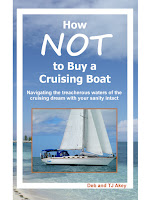
When we originally did the book, I uploaded the file to the Kindle converter that Amazon offers and the results were, well - how do I say this diplomatically - less than satisfactory. I was sort of surprised since uploading my previous children's book to Kindle went so well. I contacted a friend of ours who had recently published a novel in the same Kindle platform to ask about his experience. He indicated that he had very little trouble. His book was a straight novel with very little formatting other than chapter titles and paragraphs, but our book was full of tables, lists, graphics, and footnotes, and those were causing a world of formatting issues since Kindle doesn't support tables.
I posted in forums, asking what others were doing and began to experiment with the various programs they suggested. The results went from less than satisfactory to just downright bad. I would get it looking good in one version of Kindle and it would look terrible in another. Frustration ensued, and, all the while, comments were pouring in from our Facebook pages asking when the Kindle version would be available.
One forum member suggested that the only way to solve the issue was to strip the original document of all formatting, save it as text, and begin the arduous task of formatting it in HTML code, a process that I'm all too familiar with due to my last marketing job.
You see, Kindle books are not like paper books in many more ways than you think. They have no page structure and no page numbering. The book is one continuous document with the exception of page breaks at the head of each chapter which force the Kindle reader to a clean, next screen. They also don't recognize the carriage return that you use to end a paragraph when you're writing a typical Word document, so each paragraph must be enclosed in a <p> tag. All the bold, all the italics, all the footnotes, all the chapter headings and subheadings are lost into one giant jumble of text and need to be enclosed in tags. All of the websites mentioned in the paper copy would need linked to their web pages in the Kindle copy. There were a lot of links in the manuscript. One hundred and thirty-eight pages of our print book would take a substantial amount of time to code. I had the skills, but with the boat on the hard and projects begging for attention, I was less than enthused.
One forum member said that he had good luck with a program called KindleWriter2, a program designed to input the code quickly through the use of a toolbar with all of the codes Kindle accepts (and they don't accept very many). I went to the site and saw that they had a 30-day free trial so I downloaded it. In short order I had my text imported and most of the formatting done. There were a few wrinkles, for sure, most of them involving the Table of Contents which becomes linkable in the Kindle, but an email to the author resolved those quickly. It took a week from the day of download to the day of publish, but a good bit of that time was fixing errors in my original manuscript that had been missed, and in converting tables to lists, and in sizing graphics. I also took time to fix the original paper manuscript errors and to send them in for revision, something you can do with Amazon since they print on demand as the book is ordered.
The Kindle version went live this morning and I am one happy camper. So, if you're thinking about selling everything and buying a cruising boat and sailing off into the wild blue yonder, we'd love to see you buy the book. If you already bought the paper version and would like the Kindle one as well, you can get one at a greatly reduced price through the Book Match program on Amazon. Whichever version you buy, the dollars will be well spent, I promise you, and may save you a ton of money and heartache down the road. If you like the book, please consider leaving a review on Amazon because the reviews help our sales and we're trying very hard not to have to park the boat and go back to work. We'd also love to hear your comments here on the blog after you've read the book. Just go easy on us - we're very tired writers.
So now, if it's OK with everyone, I'm going to take a little writing break before I start on the next children's book. And while I'm reading on my Kindle, I think I'll be a lot slower to criticize an author for spelling or grammar errors because I know the nightmare they went through.
(Ed Note: In the continuing saga, it seems Amazon somehow unlinked the Kindle version to the print version so the Kindle version only comes up in the search if you specifically choose the Kindle Store in the dropdown menu. They are in the process of fixing it.)
If you ever thought you might want to write a book and then turn it into a Kindle book...be prepared for a bit of a nightmare.
When we originally did the book, I uploaded the file to the Kindle converter that Amazon offers and the results were, well - how do I say this diplomatically - less than satisfactory. I was sort of surprised since uploading my previous children's book to Kindle went so well. I contacted a friend of ours who had recently published a novel in the same Kindle platform to ask about his experience. He indicated that he had very little trouble. His book was a straight novel with very little formatting other than chapter titles and paragraphs, but our book was full of tables, lists, graphics, and footnotes, and those were causing a world of formatting issues since Kindle doesn't support tables.I posted in forums, asking what others were doing and began to experiment with the various programs they suggested. The results went from less than satisfactory to just downright bad. I would get it looking good in one version of Kindle and it would look terrible in another. Frustration ensued, and, all the while, comments were pouring in from our Facebook pages asking when the Kindle version would be available.
One forum member suggested that the only way to solve the issue was to strip the original document of all formatting, save it as text, and begin the arduous task of formatting it in HTML code, a process that I'm all too familiar with due to my last marketing job.
You see, Kindle books are not like paper books in many more ways than you think. They have no page structure and no page numbering. The book is one continuous document with the exception of page breaks at the head of each chapter which force the Kindle reader to a clean, next screen. They also don't recognize the carriage return that you use to end a paragraph when you're writing a typical Word document, so each paragraph must be enclosed in a <p> tag. All the bold, all the italics, all the footnotes, all the chapter headings and subheadings are lost into one giant jumble of text and need to be enclosed in tags. All of the websites mentioned in the paper copy would need linked to their web pages in the Kindle copy. There were a lot of links in the manuscript. One hundred and thirty-eight pages of our print book would take a substantial amount of time to code. I had the skills, but with the boat on the hard and projects begging for attention, I was less than enthused.
One forum member said that he had good luck with a program called KindleWriter2, a program designed to input the code quickly through the use of a toolbar with all of the codes Kindle accepts (and they don't accept very many). I went to the site and saw that they had a 30-day free trial so I downloaded it. In short order I had my text imported and most of the formatting done. There were a few wrinkles, for sure, most of them involving the Table of Contents which becomes linkable in the Kindle, but an email to the author resolved those quickly. It took a week from the day of download to the day of publish, but a good bit of that time was fixing errors in my original manuscript that had been missed, and in converting tables to lists, and in sizing graphics. I also took time to fix the original paper manuscript errors and to send them in for revision, something you can do with Amazon since they print on demand as the book is ordered.
The Kindle version went live this morning and I am one happy camper. So, if you're thinking about selling everything and buying a cruising boat and sailing off into the wild blue yonder, we'd love to see you buy the book. If you already bought the paper version and would like the Kindle one as well, you can get one at a greatly reduced price through the Book Match program on Amazon. Whichever version you buy, the dollars will be well spent, I promise you, and may save you a ton of money and heartache down the road. If you like the book, please consider leaving a review on Amazon because the reviews help our sales and we're trying very hard not to have to park the boat and go back to work. We'd also love to hear your comments here on the blog after you've read the book. Just go easy on us - we're very tired writers.
So now, if it's OK with everyone, I'm going to take a little writing break before I start on the next children's book. And while I'm reading on my Kindle, I think I'll be a lot slower to criticize an author for spelling or grammar errors because I know the nightmare they went through.
(Ed Note: In the continuing saga, it seems Amazon somehow unlinked the Kindle version to the print version so the Kindle version only comes up in the search if you specifically choose the Kindle Store in the dropdown menu. They are in the process of fixing it.)
Monday, June 15, 2015
Not ever perfect...
Posted by
TJ
When my grandfather was a very young man he was a Teamster. He was a Teamster when that meant driving teams of horses as the primary way of getting heavy things moved. He followed the “horse power” as it became a description of the amount of force an engine could apply to the same task of moving heavy things. Though he spent some years driving those new “teams” his real talent lie in keeping the new engines running. That made him a member of the very first generation of people who could rightly be called “mechanics”. One of the things he taught me was, “Getting it perfect will always be in the way of getting it done.” Words of wisdom for anyone who pays the bills by pushing completed jobs out the shop door.
It is a bit of wisdom that applies equally well to airplanes, motorcycles, boats, houses, and books.
Among the projects we have worked on while being back on land for a while has been the final edit and revision of our book, How NOT to Buy a Cruising Boat. It was a different kind of project for us, not nearly as much pure physical effort as most of our projects, more fun in a way, and more frustrating as well. No matter how many times the written page gets reviewed, no matter how many talented people are doing the reviewing, at each new reading another imperfection will stand out, demanding to be fixed. The same word used too often, some awkward phrasing, and spelling and punctuation errors. Those, I was surprised to find out, are often open to debate among experts in English and writing. It turns out some of the "codes" are more like suggestions. But one still needs to work on getting it as correct as possible. But not perfect. Not ever perfect.
But we did get it done.And so my bone-headed, often misguided, bumbling path from living in a house to living on a boat is out there for everyone to see, laugh at and, hopefully, learn from. There are surely other ways to do it wrong as even I can't make all of the mistakes myself. How NOT to Buy a Cruising Boat is my story of getting here in spite of myself. For any who are working at their own "Retirement Project" we offer it as a red flag set along roads we found rutted, potholed, and barely survivable; with hopes the reader will find an easier one that leads to the dream of cruising.
Along with being as honest as I can be about my own stumbling, there are some very harsh assessments of much of the boating industry. To my friends who are members of that industry who, in no way, deserve to be in the line of fire, all I can say is, "Sorry". Your dedication and help was fundamental to us making it "out here" but, in my experience, you are in the minority. Without you the cruising world would have collapsed into a playground exclusive to the very rich long, long ago.
Ed Note: The book is available on amazon.com. At the moment, only the printed paperback is available but the Kindle version will be released soon.
Subscribe to:
Posts (Atom)


