Saturday, February 18, 2023

Pre-trip Trip Notes

We are back on First Light after the normal 2 day / 15 hour drive. The plan is for this to be the last pre-trip trip. Priorities for this visit are to have the gen-set generate, the depth gauge show how much water is under the boat, the AIS tell us where other boats might be, the stern nav and spreader lights to actually light, the horn to honk, see the Dink in its fancy pull-it-up-on-the-swim-platform kit position, and paint the trim stripe so that bit of major ugly stops driving me crazy. Those are just the highlights of THE LIST. There is little to no chance it will all get done before heading back for a semi-final stint at work. Semi-final because the folks I work for will not grant a leave-of-absence for the purpose of moving a boat. So I told them I would be handing in my notice. That seemed to catch them a little off guard and they then assured me I would be welcomed to reapply as long as we returned within a year. They will even count the  years I have been there toward things like vacation time. But the final decision to return lies after  First Light is safely in St. Louis. Many a nautical mile lay between now and then, though I think it a fair chance that the trip costs will suggest a return to gainful employment might be a good idea.

What does not get taken off THE LIST this trip we will do in April before heading out. A good guess is that we will stay here in Oriental for a couple of weeks before dropping the dock lines for a last time and heading north. From what I have been hearing from Deb, the half a loop trip is going to be at least as much of a challenge as was getting Kintala down the ICW and over to the Islands our first year out. From here to the North end of the Chesapeake Bay is pretty familiar ground. But after that?

There are lots and lots of locks and locks. There are places where the water is both narrow and shallow, similar to the Rock Pile. First Light draws a little less than did Kintala, but she has two big propellers hanging down as the first things to gouge Mother Earth. Kintala had 9,000 pounds of lead that hung under her hull protecting a tiny bow tie of a prop, something we put to the test on more than one occasion during our years as live-a-board cruisers. 

There is a Great Lake that sank the Edmund Fitzgerald that would not think twice about putting First Light on the bottom. (I know, the ocean has sunk a lot of boats. One expects that kind of thing from an ocean. But a lake?)  There are drunken weekend power boaters, uncounted barge challenges, and commercial shipping galore all squished into rivers...tiny ribbons of water that one can see across. The only thing not to worry about is opening bridges. With rare exception, First Light does not need the bridge to open; she will just scoot along under the span without pulling the bridge tender away from his iPad. So, though we are staying mostly in US waters and not tackling anything like the Gulf Stream, it still seems like an adventure in the making, with many new things to see and learn. Why else live on a boat? 

No, it's not any standard nut...

Day One: While Deb worked relentlessly trying to find the right parts to get the windshield wipers to work: (Windshield wipers!) I started on the exterior paint. The morning found the day a bit chilly with a stiff wind blowing. Fortunately, by the time taping and scotchbright work was done, the wind had settled and the sun was shining. So on went the first layer of dark blue. This is ten-foot paint work. But one coat in and, from 10 feet away, First Light is starting to look like a boat that is cared for. (Pay no attention to the rail teak, that is on the list as well.) With paint drying, I started with other items on the THE LIST. It turns out the horn actually does work, so long as one presses the button and holds it in. Apparently it needs tickled before it will honk.

Before...


After!


All it took to repair the aft nav light was installing a whole new light fixture. The old one came off in bits and pieces. Not sure why it was still hanging onto the boat. We managed the install without dropping anything into the water (thanks to the old hang-an-umbrella-upside-down-below-the-work trick). Not the norm for this trip so far. Already a knife, a part of a guitar stand, and the cap for our mineral spirits bottle have taken the plunge and disappeared...

After ordering parts for the windshield wipers, Deb started poking around the navigation system and, in the process, fixed the depth sounder. A plug had pulled partly out of the display unit. Not far enough to hang down where it could easily be spotted, but far enough that when she started to trace the wiring, the plug pulled the rest of the way, hanging down where it could be spotted. (Remember the old joke about making sure the TV is plugged in before calling in the repair man?) Tomorrow we will add a clamp to support the wires and that problem should be solved. Day one has been a good day. 

Day Two: Deb spent the day in the flying bridge removing old sealer, cleaning up tape goo, and getting ready to reseal all of the seams. There is a good bit of water damage in the salon, apparently caused by water leaking through from the flying bridge. We have already chased down some clogged drain lines, cleared some and replaced others. I'm pretty sure every boat that ever was leaked a bit somewhere. First Light is no exception.

I started the day with an attempt to fix the spreader lights, only to discover that there are no spreader lights. Which shouldn't have come as a surprise since we could not find a switch or circuit breaker anywhere that looked to be associated with spreader lights. Yet there were two light-looking things hanging off of the radar arch, complete with what appeared to be bulbs. It seemed logical to try make them work. But when I went to take them down they literally disintegrated in my hands, the rusted parts falling into big bits and dust. The only wiring to be found anywhere near the apparent fixtures were two little stubs attached to what was once a light bulb socket. The only thing I can figure is, when the cover over the aft deck was added, it was decided that the lights didn't actually serve any purpose except to light up the top of the cover. But instead of removing them they were just left hanging there, slowly corroding back into the constituent materials from which they were forged. They are gone now. The starboard side is plugged and sealed. On the port side, which hangs over the ladder to the flying bridge, we are thinking about mounting a solar powered flood light. Seems like a good idea for going up the ladder in the dark.

The rest of my day was spent applying a second coat of paint and cleaning up the mess. While I did that Deb met with an electrical / navigation systems guru. As it turns out the AIS works just fine if one pushes the right buttons. We also learned that the chart plotter will, in fact, guide the auto-pilot along a pre-plotted route, just like the jet I fly. So First Light has the nautical equivalent of a Mode S transponder (for traffic), an FMS for routing and auto-pilot control, and RADAR. I'm feeling right at home in my floating cockpit.

Day 3:  The Dink was the focus of efforts first thing this morning. First Light is equipped with a fancy rig that allows the Dink to be levered up onto the swim platform to rest on its starboard pontoon. At the same time the engine pivots to keep its vital fluids from leaking all over the place. Kind of cool but the Dink then blocks the regulation required boat name and hailing port on the transom. The previous owner to the previous owner painted that info on the bottom of the Dink for all to see when the mother ship is underway with the Dink stowed. Nice idea except the previous owner had changed the name (that we kept) and and hailing port is now St. Louis, MO.  We needed to sand off the old info and apply a new coat of paint. We decided not to paint the info on the Dink and will make a banner with the required info be hung between the the aft roof supports when underway. Tomorrow, after the paint dries hard, we will toss the dink in the water and see about making the fancy rig work.

Also accomplished was the install of a camera that allows us to look at the boat's aft deck and main cabin via the internet. It swivels and tilts and even has a speaker. It has its own solar panel for power and the whole install took a couple of hours. Not bad for a boat project. We have two more cameras to mount in the engine room so we can keep an eye on things without crawling into that hot, noisy, and somewhat hazardous space while underway. 


We also had a diver look at the bottom and the zincs. The ones on First Light, in the water for a total of barely 3 months, are already 20 to 30 percent gone. I learned today that one should not put all the zincs on at the same time, particularly when one has two on the running gear. That way both will not fail together, leaving the running gear to melt away. Zinc replacement is going to be an ongoing maintenance item. Those things are not cheap and First Light sports eight of them. Rumor has it that zincs tend to go away much faster when a boat is on shore power. We hope to avoid slips for much of our half-a-loop trip, hopefully easing the zinc melt rate. 

Much to my delight the diver also found the knife I dropped into the water the day we got here. I am generally not the sentimental type and losing a knife overboard is certainly nothing to get upset over. But that particular knife was a gift from two of my grandsons back when that branch of the family was also living on a boat and we were traveling together. I have been carrying it for very nearly 10 years now. Just reaching for it reminds me of that time together. So having the diver pop up with it in his hand made me smile.

The day ended with us being invited to an open mike night at a local eatery. It was a fun time with a singer worthy of a record deal, a couple of guitar players that were pretty good, a sax player who was really good, and included a stint of blues harmonica that was first rate. Among those stepping up was a talented Ukulele player with a Baritone Uke. I happen to have a Baritone in my collection, currently with us on the boat. I own eight Ukes of various size and tuning, love playing them all, and am not near as good as our new friend Bruce. Not only is he a better player than I, his collection is bigger as well. I'm not sure of which is more impressive, his talent or his collection. (There is still some decisions to be made as to which of my collection will be onboard when we head out. Four, plus Deb's guitar and my table top drum kit, is the current tally. But the 5-string and Bass are not on this list.)

All in all a really good day.

Day Four: With the paint on its bottom dried, we wrestled the Dink over the side rail and into the water. With the big boat pulled forward in the slip to make a little room, we alined the little boat with the swim platform and started fitting pieces together. With the Dink firmly attached to the swim platform by swivel gear, we tied a line to what looked to be a good lifting place and tried to pivot the thing up out of the water. We didn't make but a few inches of progress—too much weight at too shallow an angle. So the debate started. I was of the opinion that nothing short of a 4 to 1 pulley rig mounted to an aft deck roof support for a better angle, would get the job done. Deb insisted that couldn't be the case since the previous owner made it work with no such permanent mount, nor was there a pulley rig with the other Dink hardware. We tried a couple of different approaches with no progress. Then Deb got that look in her eye that suggests she is onto something and went hunting. A few minutes later she came down from the flybridge with a 4 to 1 pulley rig she found stashed under the upper steering station. (I think she saw it when she was under there fixing the depth finder and realized what it was for while I was fuming about drilling more holes in the boat.) With one end hitched to an aft cleat and the other on an obvious lift point...success. It is not an easy lift but it works. So we were both right. It did take a 4 to 1 purchase and the previous owner had already figured that out. I am not completely satisfied that it is as good a rig as we can come up with, but it will certainly do for now. The day ended with the Dink is in its resting place on the swim platform.


We had hoped to fit the motor to the Dink today as well. But the little boat started taking on water as soon as it landed in the wet stuff, (Adding a bit of incentive to get the thing up on the swim platform.) A close look showed the water coming from around the drain assembly where it mounted in the transom. So we pulled, cleaned, resealed, and reinstalled the whole thing. Tomorrow, depending on the weather, we may take another shot at the mounting the outboard. All in all today didn't feel as productive as yesterday, but progress is progress and fixing leaks is always a good thing. Another good thing is the view out the forward windows with the dink off the foredeck. There is a lot of boat out there! Tomorrow is the last work day before heading back to St. Louis. Weather will decide what projects fill the day.


Day Five: We finished day four puzzled by the new (and totally irritating) noise that started coming from the refrigerator late in the evening as we got ready to hit the rack. Though we had other plans for today, seeing if we could quiet the fridge rose above the Dink motor on the get-it-done list. But first was a chance to have some morning munchies and coffee with friend Mike from cruising days gone by. His Cat is in a yard about an hour''s drive from here where he is getting some work done.  It has been a long time since our last visit and such a chance should not be missed. We talked boats, plans, the state of the world, and the generally miserable quality of marine industry maintenance support. Though I have to admit that our experience with marine maintenance support and First Light has been the exception that makes the rule. Engine, bottom paint, electronics, just the general helpfulness from the people at Duck Creek and now Oriental; we are on a bit of a run when it comes to the best boating has to offer its participants.

After a while Mike allowed as he needed to get back to working on his boat. Deb and I certainly needed to get back to work on First Light. We traded a heart-felt goodbye and got back to the business of being sailors: working on the boat.

Back at the boat we pulled the 'fridge from its cabinet and started poking around. Nothing seemed amiss with the unit itself, but there was a bunch of wiring and connection boxes unrelated to the fridge sharing the same space. None of it was secured in any way with lots of things to bounce off of nearby. We tidied up the wiring and secured the boxes, pulled and cleaned the fridge fan (not finding anything amiss with it) cleaned the whole space up and...the fridge ran with nothing but a barely audible hum to be heard. What remained of the rest of the day was spent on minor projects and deciding what tools to leave on the boat and what needs to go back to St. Louis. As the sun set, we set off for  a Pot Luck diner with folks from the marina, hosted by a sailing couple Patty and Andrew. They are in the process of refitting a Kadey-Krogen 42 for departing Oriental on their own great loop trip starting this spring. It may be that we will have a partner boat for at least part of our journey. How much fun could that be? The evening ended with us saying good-by to a whole group of new friends. There is no better way to end a day (or a week) of working on the boat. 

Day Seven...and we are home. And I leave you with some of the beauty that is Oriental, NC.


Thursday, November 3, 2022

First Flight of First Light

The plan had been to spend one more day in New Bern, meet some old cruising friends for dinner, blow that pop stand the next morning and head to Oriental. But this morning's check of the weather suggested that today was the day for making good our escape. A few phone calls later and new plans were made for having the car catch up to us. With goodbyes said and hands shaken with the folks at Duck Creek (who have been as helpful as they could be for the last year) we headed down the dock to get underway for the first time in just shy of 4 years.

First sunrise on First Light. And a beautiful first light it was.
One of the reasons we love the boat name and didn't change it.

We scurried around trying to remember all the “heading out” chores that needed done, and to figure out which ones apply to trawlers. Obviously uncovering the sails and running the sheets and halyards wouldn't be necessary. Engine oil checks? Yep, x 2 though all the fluids were changes yesterday so that seemed redundant. Still, Deb suggested I look over the engine room anyway. I did: and put away the fan that had been left in there, stowed a half bottle of coolant sitting by the port engine, picked up some stray wiring, and moved a tool box back to where it belongs. Pre-engine start engine room check is now on the departure “must do” list. Then we talked over how we were going get out of the slip, down the creek and into the Neuse River. It has been a while since we reviewed nautical charts.

Painting the stripe is very very high up on the Captain's to-do list.
 

When we couldn't come up with anything else needing done, I fired up the engines(!) while Deb pulled in the lines. A few bumps forward with the shifter levers, a few bumps back, and we cleared the dock without much ado. It was a slow and careful crawl down the creek as, along with the gen-set, the depth gauge that had worked during the sea trial stayed dark and dead in the panel. First Light draws less than four feet, but it is still spooky poking along without knowing just how much water is under the keel. A cool thing was that the upper chart plotter, which didn't work yesterday, lit up this morning without hesitation. RADAR! For the first couple of miles the helm felt very weird. Hydraulic steering takes a little getting used to. What took zero time to get used to was bringing the auto-pilot on line and just punching in the required headings. At some point we will figure out how to make it track a route, but for now, after the years of wrestling Kintala's wheel for hours at a time, heading hold was more than enough of a giggle.

The Neuse taught us some pretty harsh lessons in the past. More than once we limped into Oriental beat up, broken, and looking for a place to hide. But today? Today was as perfect a day as one could have for first trip in a new-to-us boat. Traffic was light, as were the winds. The slightest swell rolled under the bow while wavelets from the port side didn't move the boat at all. After the truncated, rigging-blocked view from the aft end of Kintala, the expanse of water visible over the bow of First Light was nothing short of amazing. At one point a King Pelican took flight off our bow. The only thing missing was a visit from a dolphin, welcoming us home. The hours strolled by as some of the very best we have ever enjoyed on a boat. It was hard to grasp that we made it, that we were back on the water and moving at our own pace.


Back in the day, when a marina came into view, the adrenaline started to flow and the brow started to furrow. Getting Kintala onto anything but a face dock in a calm wind was far more luck than skill. As great a sailing boat as she was, docking was a nightmare. Backing into a slip was generally completely out of the question. In fact, as I sit writing this and looking at the boats around us (with one exception) the only ones stern-to are trawlers and catamarans. And I know why. Deb talked me into the marina and down the right fairway. We counted slips and spotted an empty one that looked to be ours between a Lagoon 40 Cat and that stray sailboat parked stern-to. Today there was a little wind blowing but it made no difference. First Light obeyed my commands without complaint, eased back into the slip and stopped right where I asked. Deb set a couple of lines to hold the boat still, I shut off the engines, we set fenders, added lines, hooked up to shore power, and called our first trip a complete success.

For the next couple of days we will enjoy one of our favorite towns from our previous cruising days, get some more work done on the boat, and marvel at just how lucky we have been. 


The reflections from the sun on the water in the cabins is one of the things I missed most
when we returned to land. It's amazing how much these little things all add up to make
this life as wonderful as it is.


Wednesday, November 2, 2022

Launch Day...

We have been through a lot of launch days; Nomad, then Kintala, and now, First Light. Each has come with a certain amount of trepidation, which I find odd. I flew airplanes for a living, still do once in a while. Literally thousands of launches were made into stormy, or ice filled, or minimums weather skies. There were maintenance flights and first flights on just built or heavily modified airplanes, some of which limped home with engines shut down or other abnormalities. (Probably why they are called “test flights”.) There were delivery flights in neglected airplanes that had been sitting on the ground for years and were no longer “serviceable”. Those flights required special permission from the Federal Aviation Agency and came with strict limits as to when, where, how high, in what weather conditions the plane could be moved, and who was allowed on board, always minimum crew only. A mechanic (me) had to certify that the aircraft would (likely) make the flight in more or less one piece. Then the pilot (me again) would jump in and go. As might be expected a lot of those flights involved a certain amount of...shall we say, “adventure”? Then there were the flights into some of the busiest airports on the planet: Chicago, Denver, LA, DC. And flights to and from dirt runways with questionable lighting deep in the Rocky Mountains. Yet never, in all of those thousands of “launches” into a possibly hostile sky in sometimes questionable equipment, did I experience the kind of butterflies that come with launching a boat.

Of course the lift time was delayed. Though we were first on the day's schedule another boat pulled into the pit late last night. It was suffering some kind of a failure that required it be lifted first thing in the morning. By the time it was out of the water, bottom scraped and pressure blasted, and sitting on stands, most of the morning was gone. We had been up since 0600 getting First Light ready to splash. All we could do was take walks around the yard and try to ignore the butterflies.


Eventually it was our turn. First Light was eased off of the stands, moved, then lowered gently into the water. Except for the sea trial it was the first time the boat had been floating in nearly 4 years. She has been on the hard nearly as long as we have.


Then came the fun part. I got to drive the boat through a very crowded marina and back it into our temporary slip-for-the-day (or two). It was a chance to warm the engines and transmissions as we had an engine expert standing by to change all the fluids and filters once tied to the dock. It was also the very first time for your's truly to helm a twin-engined trawler. Caution was the word of the day, but the minute we cleared the lift pit something became wonderfully obvious. One has far more control over where this boat is going when slow and in tight spots than was ever available on Kintala. It was a 180° turn out of the lift pit. Then it was a run down a narrow fairway lined with boats to be followed by another 90° turn to port. After that it was time for a 90° swing, bow to starboard, while backing into the slip, this in a fairway only slightly wider than First Light is long. And it was no problem at all. Mind you, the wind was less than 5 knots so no “big boy” points were accrued. But...DAMN!


We were both a little buzzed after tying off in the slip. The engine expert took over. It was near the end of the mechanical work when the first problem reared is head. There is something wrong with the ship's generator starting circuit. Though the gen-set worked just fine during the sea trial, it is now an inert lump sitting at the back of the engine room. After a bit of poking and prodding deep in the tangle of wiring taking up space in the control unit, our expert engine guy allowed that he was getting out of his depth. (The mark of a true expert is someone who knows what he doesn't know, and is willing to admit it!) But he happens to know an expert generator guy. But it all came out even as our expert engine guy is also an air-con expert. He cleared a simple airlock and showed me how to properly power up the system. Shazam! Cold air. (Not that we plan on using it much. But it is nice to have.) 

Our engine expert, Darrel from Foster's Mobile Marine


The next problem to peak over the transom was a recurring glitch with the Raymarine plotter at the upper helm. In this day of smart phones and iPads, such is not much of an issue insofar as navigation goes. But it is also the screen for the onboard radar. RADAR! How cool it that? Turns out the engine guy also knows a Raymarine guy. If we can't figure it out, someone will. 

So, at this very moment of typing, I am sitting in the covered Fly Bridge, enjoying a cold one, feeling the boat move gently, and listening to the wildlife playing in the sea grass. Around me is a venue of pure joy, afloat in a marina once again, surrounded by water, and boats, and trees. I walk a dock to get to the boat, step on board without climbing a ladder. It is hard to explain just how perfect it all feels.


In the next day or two we will head down to Oriental where First Light will stay until Spring. In between, St. Louis still calls (though at least two trips to the boat are planned). There is family I am already missing a little. There is also an income that will help cover those last few items I would like to have working before we head off once again. But, at least for now, it feels like we have made it back. And it feels good.


The painter's dog seemed a little nonplussed at the removal of his shade boat


Wednesday, October 5, 2022

Decisions, decisions, decisions...

It has been more than a year since we purchased First Light. Having her on the hard this long was not part of the plan...not that we had much of a plan. When we left Kintala, our intent (plan if you will) was to get back on the water as soon as we could after my two year commitment to the job was over. We knew it would be in a different boat, exactly what kind still to be determined. Once we were back on the water roughly half a year would be spent cruising with the family we left behind living on their own boat. The other half would be spent here in St. Louis, enjoying the life that has unfolded here. It would be the the aquatic equivalent to the retired couple who takes to RV living, bouncing around the country to catch up with the people they love scattered across the country. It has been nearly four years since we returned to land; buying First Light was a commitment to making it back "out there."

As the months went by, we managed multiple trips to our new-to-us trawler. Trips spent (as was expected) getting the thing ready to splash. And we are getting close. But life has a way of changing things up. The family that lived on a boat now lives in Kansas. Kansas, as you might be aware, is far, far, (far) away from anything like big water. Indeed, it is about as far away as one can get from the water while living in the US of A. This required some serious rethinking about how we wanted to go about living.

Our first adventure of full time cruising meant more than half a decade of seeing the people we love most in the world just two or three times a year. Being away from growing grandkids was a heavy burden that came with the lifestyle. Until then, I had never faced that kind of heart ache. It was serious. More than once tears flowed while sitting in a beautiful anchorage, thinking of those far away. Facing the same kind of goodbyes that came with our first foray onto the water did not hold much allure. Going back to it only worked when leaving our land-based family was temporary, while the other side of the equation meant pulling up to our water based family and dropping anchor next to them. 

Then again, even with the heart ache, and having no family to meet "out there," being land locked for the rest of our lives doesn't hold much allure either. So the long debates started. What do do with First Light, how to make this work? How to balance being drawn in two opposite directions? How to be with family and still satisfy the wanderlust that resides deep in both our our souls? 

It was always assumed that, when our return to full time cruising no longer made sense, First Light would end up on a dock not too far from St. Louis. So, a few weeks ago and still not knowing what the short term plan might be, we did some looking at the long term. A weekend spent scoping out the marinas along the rivers surrounding St. Louis ended in Alton, IL. After a little bit of debate we decided that Alton would, eventually, be First Light's semipermanent home. It is within easy reach of our land side St. Louis home. There are rivers to explore with places to anchor out for long weekends. And there is a massive lake just a day or two's journey way. We could, when we felt like it, just spend time on First Light while on the dock, living the boat life and heading out for an adventure whenever we felt the need. First Light will become our (floating) cabin out in the woods. But between now and then? No real clue.

Things putter along as things tend to do. We set tentative plans to depart sometime late this year, literally within the next several weeks. The thought was we would take First Light to the Islands one more time, then bounce around for a while. Eventually we would head back to the States, wander around the Keys, along the West coast of Florida, and up the rivers, and end up back in St. Louis. We would be doing the bottom half of the great loop, only going backwards and against the current. Once in St. Louis we would take up our no-longer-full-time-cruisers lifestyle. But there was one little hitch in that plan. What to do with me after we settled in? 

We have survived these last few years on land because of a few very fortunate breaks. The first was that of ending up in a perfect living arrangement. A small apartment literally just yards aways from family we love and deeply missed during our years on Kintala fit our minimalist lifestyle. And second, I ended up at a job that is interesting, basically painless (unusual for jobs in my experience) and pays pretty well. That last is important for two reasons. The first is, not to put too fine a point on it, the world is a seriously screwed up place at the moment. Having options because we also have resources available just feels like the smart thing to do. And the second? Deb is pretty sure (and I happen to agree) that me being land locked without something like work to keep me occupied and challenged, would be...shall we say, difficult? As someone once said, "Getting married is for better or worse, but not for lunch." 

The logical choice, at least for a while, would be for me to keep working after our return. Queries at the shop suggest that a leave of absence is possible, leaving me something to do to keep from driving Deb crazy when we get back. But for reasons I can't explain, the impending departure was making me very uncomfortable. Something just didn't feel right about the plan, but it was all we had. 

We had considered a second option, with the same approximate departure date. It had us heading north rather than south. We had not had Kintala in the Chesapeake Bay for the last couple of years of cruising. It is a place we both enjoyed. Putting around it in a trawler would be a lot of fun. We have family there we haven't seen in a long time. There was some thought of making the bay First Light's permanent playground. But it is a long drive from St. Louis and what to do during the winter was a complete blank. That plan was quickly dismissed. Having First Light in the Chesapeake full time would simply not work. Back to plan “A."

While at the shop this week, I checked with the powers-that-be about the leave of absence. There is such a shortage of airplane drivers in our part of the world that instructors are getting very hard to keep, so the shop is pretty accommodating. They will be willing to hold my job and have me back as long as I would be back, full time, in just a few months. But I did need to give them a date as soon as possible. Scheduling clients, instructors, classes, recurrent training, and available equipment is the constant nightmare of this kind of operation. Just as I was about to tell them mid December until late spring time frame when I got a text from Deb suggesting I not give them a date. A possible third option was on the table. 

Burgee for America's Great Loop
Cruiser's Association
Don't go south in the winter, go north in the spring. Do the top half of the Great Loop in the right direction, with the current behind us. A plan similar to plan “A”, but with some attractive differences.

The north half of the Great Loop is territory we have never explored. It would be a new adventure. The Islands and bits of Florida that we love have all been hammered by Mother Earth since we came ashore. Maybe we experienced them at their peak and it would be best to remember them as they were. Moreover, big as she is, First Light isn't really a big water boat. Sure she could make the Islands easy enough, and work between them.  But, truth to tell, the ICW, rivers, and bays, are likely places where she (and we) will feel more at home. Also, I am happy with the idea of there always being being a land route between us and the family, one with no international borders to be crossed. And the best part of the plan? Grand kids can (if they want) come and go, meeting us at different ports of call, traveling with us for a while, and then heading back home with little difficulty. If there are no grand kids on the water to take First Light to, have the grand kids come over land to First Light.

Maybe our home for a few months?
  

This has become the new plan, and it feels right. The next trip east we plan on splashing First Light. She will take up a dock in (we think) Oriental until spring. We will use up virtually every vacation day I have to travel east and take her out to strut her stuff. But there would still be an income to cover whatever issues might come to light once her system are put to work once again. Come spring we will take that leave of absence and head north up the ICW, becoming part of the cruiser migration one more time. But, once north, we will turn into half-loopers, ending up at the dock in Alton. I'll head back to the shop and we will settle into the next chapter of our lives. Who knows, maybe some day we will head south again, cross our looper's wake, and see what might come next.

So that is the plan...for now.

Oriental Harbor Sunset


Sunday, July 31, 2022

All work and no play?

Having grandkids along on a boat work trip is a good thing, it turns out. By the end of the previous half dozen trips to the boat for Work Week we've been so tired that passing things like Pilot Mountain State Park on the drive home elicited a vague "We really need to stop there sometime and see what it's like." With the help of the boys on this trip (see Tj's previous post) we finished a day early and had time to go visit the maritime museum in Beaufort, NC and an amazingly cool wooden boat shop there. After leaving there and a night spent in a hotel with a wonderful outdoor pool, we happened to be passing Pilot Mountain State Park with a few extra hours to spare so we all voted to stop.

Pilot Mountain is a geological wonder of quartzite monadnock formed millions of years ago. The surrounding mountains eroded over the years and left the knobby formation intact. While you're not allowed to climb the knob itself, there is an easy .8 mile hike around the base of it that yields very rewarding views along the way. We have plans to return again with more time to explore. 

This is the parking lot at the visitor's center, but you can drive up to the parking lot near the top which we did. There were actually people walking all the way up the road and a few bicyclists tackling the climb on their road bikes. My grandson assures me that his dad could do it "in about 20 minutes." (The gauntlet has been thrown Dad...) There's also shuttles that go up to the parking lot if you don't want to take your car.


The elevation here is about 2400 feet.

The Blue Ridge Mountains are visible along the horizon.


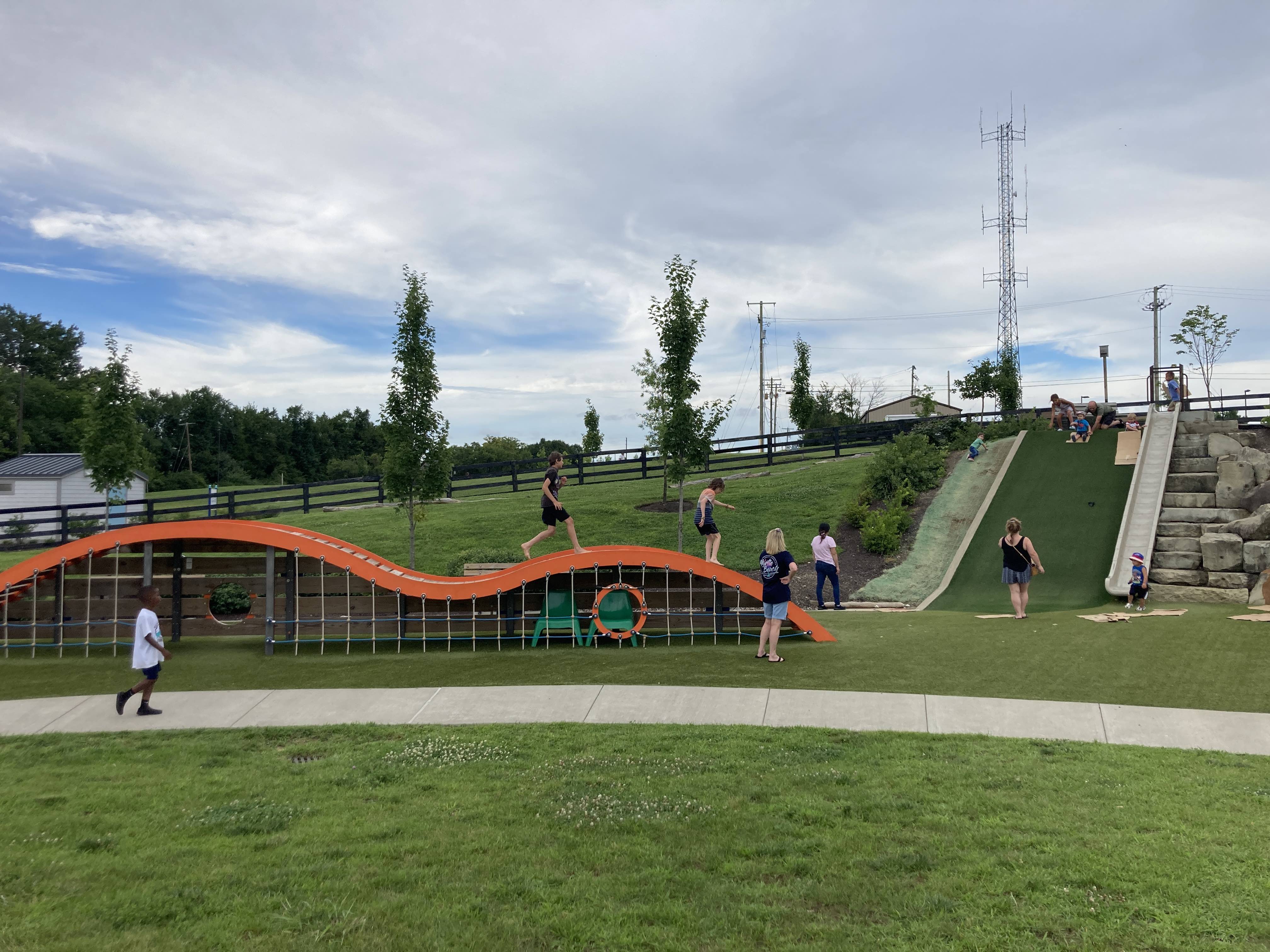
Later that evening after arriving at the hotel we found this amazing park, Legacy Grove Park in Wincester, KY. The boys had a blast climbing on everything and land surfing on the artificial turf hill. They even provided cardboard box bits to surf on.


There was a running water feature with a play area that was a creek as well as several water tables with pots, pans, pitchers, collanders, and a pumping well to get more water to play with. Another part of the park had a music feature with all sorts of drums and bells. It was an incredibly well thought out park and I wish we had one in St. Louis. The boys agreed it was the most awesome park they'd ever been to. And it was a great nudge for me to remember to balance out the work/play ratio to something just a bit more reasonable. Thanks boys!


You have to appreciate beauty no matter where you find it. This was the sunset from the hotel window last night.